The Skill Students Overlooked but Cannot Afford to Ignore
- subearclub
- Feb 16
- 3 min read


In an era where smartphones and other technological devices provide quick access to information, note-taking seems outdated.
During a seminar held on Thursday, February 12, 2026, at 11:00 a.m. in the Band Building at Shaw University, faculty members of the music department had an interesting take that not-taking is not just a classroom purpose–it's a foundational life skill. Dr. Carter, a music professor at Shaw University, addressed students directly about the cognitive importance of active engagement. “If there’s one thing you can take away from this,” he said, “it’s that actively taking notes is an important process.” According to Dr. Carter, not-taking is not about copying information and putting it down on paper—it’s about transformation. “You need to transform the information,” he explained. “Write it out in your own words… change it a little bit so it makes even more sense to you—a summary.”
His key point about transformation aligns with current research. In a 2025 study published in BMC Medical Education, titled "Cognitive Function Among University Students," they found that handwritten note-taking significantly improved memory recall and working memory compared to digital stylus note-taking. The researchers concluded that active note-taking enhances cognitive processing, reinforcing that the physical and mental effort involved strengthens learning outcomes. Dr. Carter also addressed a common misconception—that notes are only useful for later review. “It is also there to help you learn the first time,” he said. “A lot of the great ironies of note-taking are the better notes you take, the less you need them.” This highlights a deeper meaning—the act of taking notes is itself a learning strategy. Professor and piano instructor of Shaw University added another dimension to the discussion. Armstrong remarked on these technological shifts, "You will be more present with what is actually happening if you’re taking notes physically.” He added that handwritten notes slow students down but encourage deeper thinking. “Notes are a place for you to react to what’s happening,” he said, reinforcing that engagement—not transcription—drives retention.
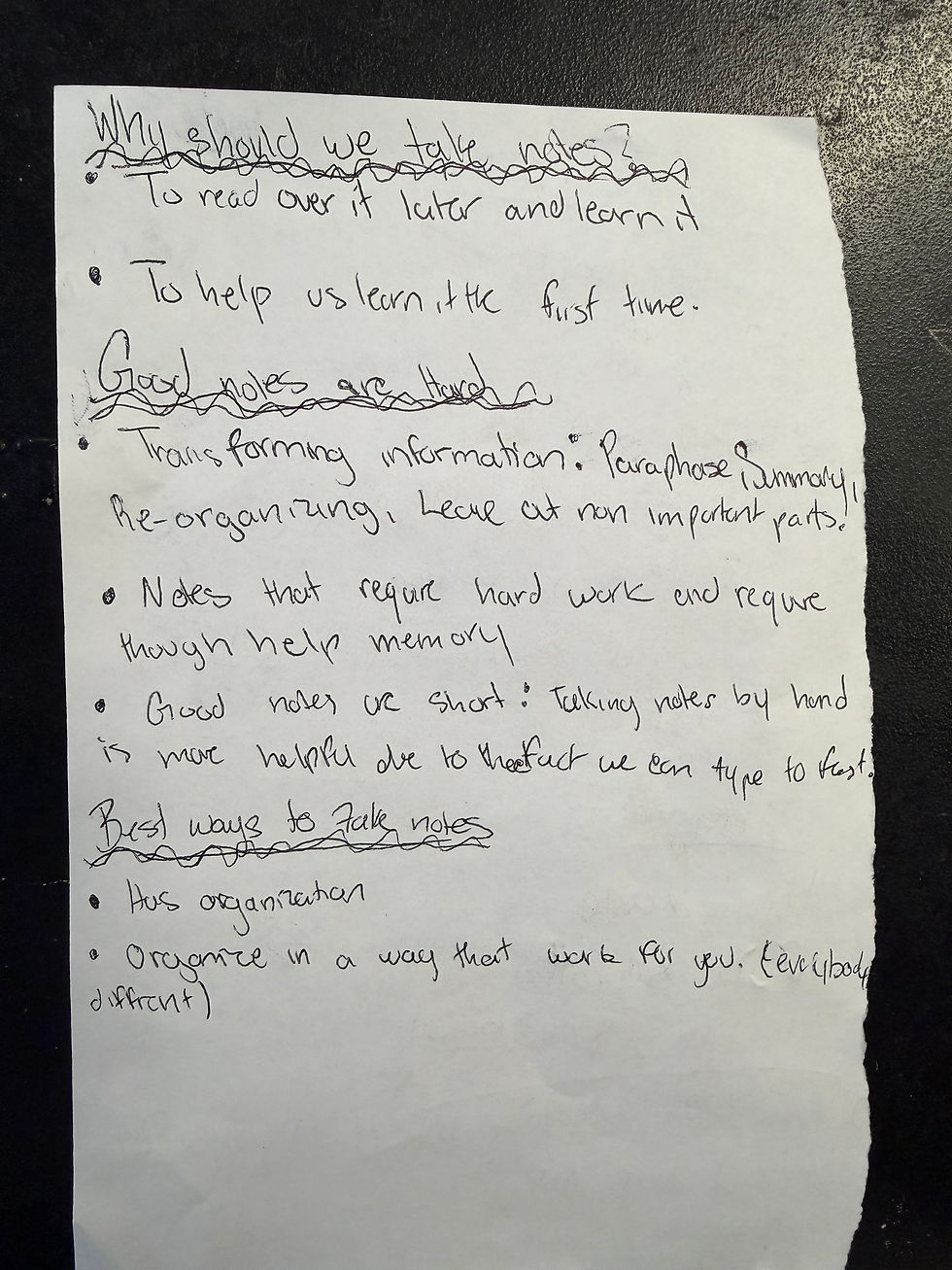
Students have also recognized these distinctions. Jay Wiggins, a second-year music major at Shaw University, shared his personal method: “I do bullet points where I would use certain words and abbreviations.” His strategy reflects organization and intentionality—two elements Dr.Carter identified as critical. “The best way to take notes has some kind of organization,” Dr.Carter explained. “You need a state that you will use.” Importantly, the seminar placed note-taking as preparation beyond life of college. “It’s a life skill,” Dr. Carter stated. “There will come a time…where you will need to learn a lot of information quickly for something important and accurately.” In professional environments that extend from classrooms to graduate programs, the ability to process, condense, and organize information efficiently is indispensable. The worst alternative, as Dr.Carter Buntly put it, “is to not take notes at all.” In a culture increasingly reliant on screenshots and recordings, students risk becoming passive consumers rather than active learners. The research is detailed: cognitive engagement matters. The seminar was clear: effort matters.
Note-taking is not busywork. It is discipline. It is present. It's critical thinking in action. And if students and day-to-day people hope to succeed–through academic careers and beyond–they would be wise to pick up that pencil.
References
Al-Sharman, A., Shalash, R. J., M Omran, T. A., Elsayed, R. M., Warfa, I. A., Elsayed Ali Adawi, W. S., Aljaberi, A. O., Alabdooli, A. A., Arumugam, A., Ramakrishnan, S., Saad, N., Ahbouch, A., Hijazi, H., Kim, M., Hegazy, F., & Nashwan, A. (2025). Exploring the impact of note taking methods on cognitive function among university students. BMC Medical Education, 25, 1218. https://doi.org/10.1186/s12909-025-07593-x


Comments